
Several executives argue that UPI has the potential to grow tenfold, but warn that the absence of a monetisation model risks stagnating the real-time payments system, which has been recording all-time-high transaction volumes every year.

'Given the lag in transmission, further softening of lending rates may happen in the coming months.'

'The statistical confidence bands of the fan charts of the forecasts will provide a better sense of the potential variability of outcomes.'

India Inc, which is sitting on cash balances of 13.5 trillion, is using the funds to meet capital expenditure as well as brownfield expansion, resulting in 'anaemic' demand for bank loans, State Bank of India (SBI) chairman CS Setty said at an event on Monday. He added that a slowdown in corporate credit is mainly due to lack of demand.

'The kind of reach it has with so many bank branches even in the remotest part of the country, it is one channel which will play a very important role in vision of insurance for all.'

Uncertainties over the impact of the United States' (US') tariffs on India, along with the ongoing transmission of past rate cuts, prompted the members of the Reserve Bank of India's Monetary Policy Committee (MPC) to maintain the status quo during the August meeting, the minutes showed. While some of the external members highlighted their concern over growth, the internal members cited the one-year headline inflation rate overshooting the 4 per cent target.
ICICI Bank has reversed its decision to raise the minimum monthly average balance (MAB) for new savings accounts in metro and urban locations to Rs 50,000, revising it instead to Rs 15,000, effective August 1. The MAB for new savings accounts in semi-urban locations has been revised from Rs 25,000 to Rs 7,500, and for rural locations from Rs 10,000 to Rs 2,500.

'MIB which is a part of retail, will grow in the range of 20 per cent.'

Bad loans in the agriculture sector remain elevated, with several public-sector banks (PSBs) reporting higher slippages in the April-June quarter of FY26. For many banks, non-performing assets (NPAs) in farm lending were 5 per cent or more, with some nearing double digits.'

Infrastructure bonds, which were relied upon the most in 2024-25 (FY25) by commercial banks to raise funds through the domestic debt capital market amid lagging deposit growth, seem to have lost their sheen in FY26. So far in FY26, no bank has tapped the domestic debt capital market to raise funds via infra bonds, and the expectation is that the amount raised through this route will be significantly lower than that last year, unless credit demand picks up.

'India is a big market for StanC, and it is also fastest growing economy in the world.'
In Q1FY26, the bank reported fresh slippages of 8,200 crore, up 71 per cent Y-o-Y and sequentially. Of this, 7,500 crore is from the retail segment.
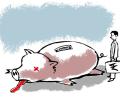
State-owned banks have received guidance from the government to close Jan Dhan accounts whose beneficiaries are unwilling to keep them active, amid rising instances of such accounts being misused by fraudsters as mule accounts to defraud people, people aware of the development said.
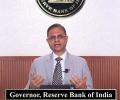
'India has the potential to grow at more than 7%, with the monetary policy providing a supportive hand.'

There is a need for real-time or near real-time credit reporting, instead of the current fortnightly system, to improve underwriting precision, enable timely reflection of borrower actions such as loan closures or repayments, and deliver a superior consumer experience, Deputy Governor of the Reserve Bank of India (RBI), M Rajeshwar Rao said on Wednesday.
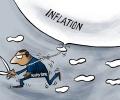
'Deposit and lending rates have started to fall considerably. It is likely to spur investment and consumption of durables.'

Large tariffs by the United States administration and elevated geopolitical risk have increased near-term global financial stability risks, and along with weather events pose downside risks to domestic growth, Reserve Bank of India (RBI) Governor Sanjay Malhotra said in the foreword to the Financial Stability Report released on Monday.

'$125 million for the hull and the remaining of over $350 million for liability.'
'Once bitten, twice shy, I didn't take up the challenge this time...' 'I realised I had failed to follow my karma because I feared failure.'

The claims will include three kinds of liabilities: Damage to the aircraft; loss of lives who were aboard the aircraft; including the crew members; and third-party liability because of loss of lives where the aircraft crashed; and cargo liability.
